
Quick Answer
To open a student bank account UK-wide you'll need a passport or BRP, proof of address, and your UCAS confirmation. Applying online takes about 20 minutes, but the full process including overdraft approval and card delivery takes 5-10 working days.
Regulatory Transparency & Disclosure: Student Invest Guide is an independent financial commentary platform. This article may contain affiliate links which support the site at no additional cost to the user.
Knowing how to open a student bank account UK-wide before term starts avoids a common problem: your student loan lands, but there’s no account ready to receive it. Most UK banks let you apply online in under 20 minutes, but approval, card delivery, and overdraft applications add several working days on top. This guide walks through the exact documents, steps, and timing so you can have an account ready before Freshers’ Week, not scrambling during it.
What You Need Before You Open a Student Bank Account
- Proof of identity: a valid passport or biometric residence permit (BRP). A UK driving licence is sometimes accepted as a secondary ID but rarely as the sole document.
- Proof of address: a recent utility bill, council tax statement, or bank statement dated within the last three months. If you’re moving from home to student housing, most banks accept your current home address at application stage.
- Proof of student status: your UCAS confirmation (a 16-digit UCAS ID), unconditional offer letter, or university enrolment confirmation, depending on the bank.
- National Insurance number: not always mandatory to open a student bank account, but useful to have ready, especially if you plan to work part-time.
How to Open a Student Bank Account: Step by Step
Step 1 — Compare accounts before you apply. Interest-free overdraft limits, welcome perks, and railcard eligibility vary significantly between banks. Decide what matters most before choosing where to open a student bank account, since switching later means starting the process again.
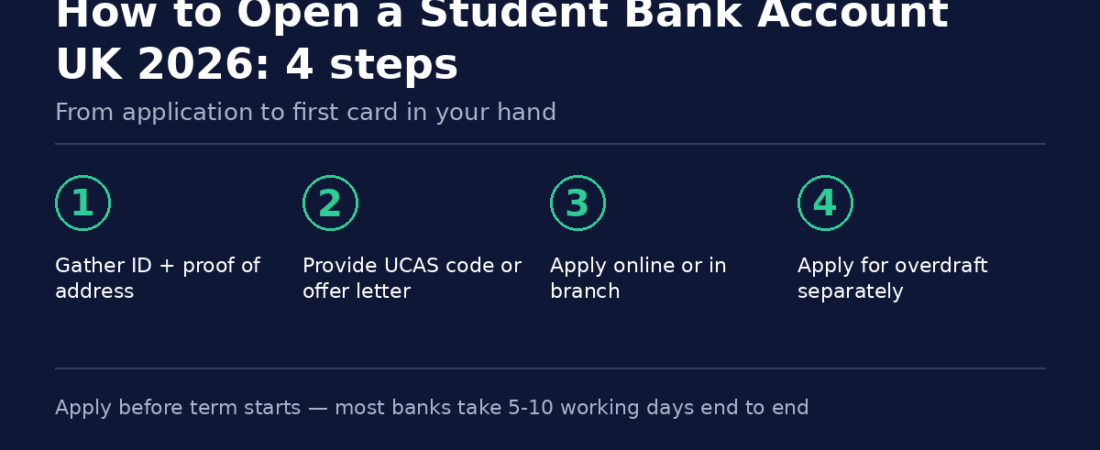
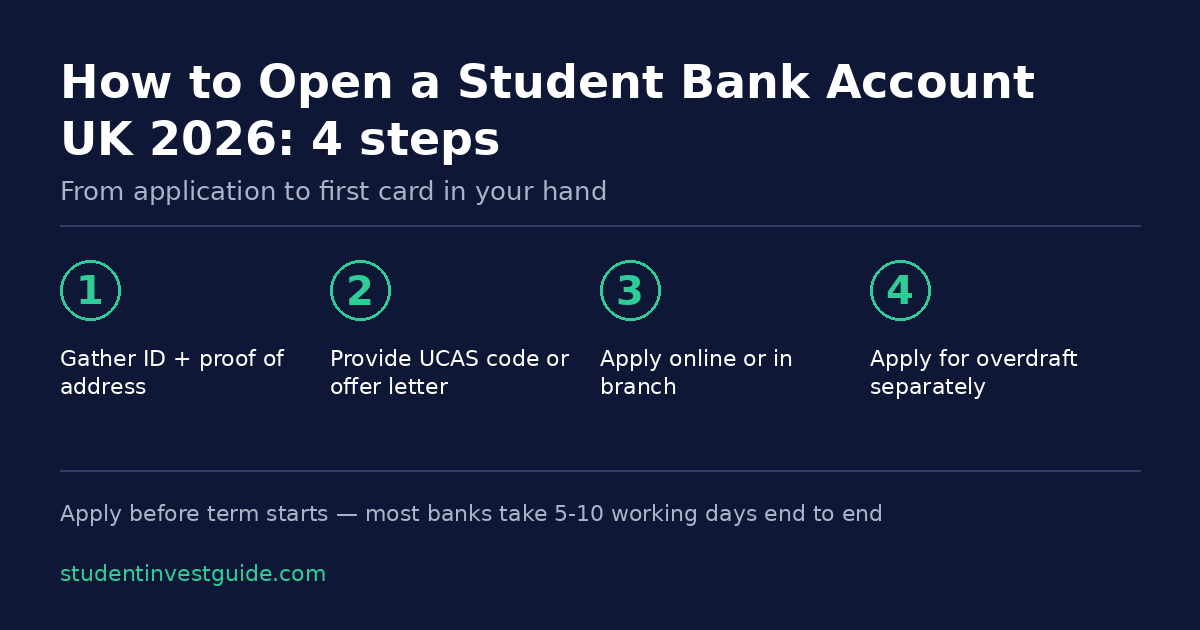
Step 2 — Gather your documents. Have digital or physical copies of your ID, proof of address, and UCAS confirmation ready. Most banks now accept photos or scans uploaded directly in-app.
Step 3 — Apply online or in branch. Applying to open a student bank account online typically takes 15-20 minutes. In-branch applications can be faster for identity verification if your documents are unusual, since staff can verify originals on the spot.
Step 4 — Apply for the overdraft separately. At most banks, the interest-free overdraft is not automatic — you apply for it after the account is open, and approval depends on an affordability assessment.
Step 5 — Set up your student loan payment details. Once your account number and sort code are confirmed, update these with Student Finance England (or the equivalent body in Scotland, Wales, or Northern Ireland) well before the start of term.
Why Timing Matters
- Avoids a loan payment gap: student loan instalments are paid into whichever account you’ve registered — if that account isn’t open and verified yet, the payment can be delayed.
- Overdraft approval takes time: the affordability assessment for a student overdraft can take a few working days on top of account opening.
- Card delivery adds days: even after approval, a physical debit card typically takes 3-7 working days to arrive by post.
- Welcome offers can be time-limited: some banks’ cash incentives are tied to specific enrolment windows, so opening early protects against missing a seasonal offer.
Apply to open a student bank account as soon as you have your UCAS confirmation — typically mid-to-late August for most undergraduates. This gives the full account-plus-overdraft process, often 5-10 working days end to end, time to complete before Freshers’ Week.
Analyst Note
📩 Get our free Student Investor Checklist — 10 steps before you invest your first £100. Download free →
Risks and Limitations
Identity verification can fail first time. International students without a long UK address history, or anyone whose proof of address doesn’t match their ID details exactly, may have an application rejected or flagged for manual review, adding days or weeks to the process.
The overdraft is a debt facility, not free money. Even when interest-free, any amount borrowed still needs to be repaid, and exceeding the agreed limit typically triggers unarranged overdraft charges.
A realistic underperformance scenario. If your student finance application is delayed, having your account open early doesn’t guarantee your loan arrives on time — you may still need short-term budgeting or family support to bridge a gap.
Switching later has real friction. If you open a student bank account with one bank and later find a better offer elsewhere, moving means updating your student loan payment details, any Direct Debits, and waiting through a new account-opening process.
What Documents Each Major Bank Typically Requires
| Bank | ID Accepted | Student Proof Required | Typical Timeline |
|---|---|---|---|
| NatWest | Passport or BRP | 16-digit UCAS code | Same-day account, overdraft separately assessed |
| Santander (123 Student) | Passport, BRP or UK driving licence | UCAS confirmation or enrolment letter | Account instant, full overdraft unlocks after £500 paid in |
| Barclays (Student Additions) | Passport or BRP | UCAS confirmation or enrolment letter | Same-day account, overdraft subject to separate application |
Figures correct as of July 2026, based on each bank’s published requirements; exact processing times vary by individual circumstances.
Opening a Student Bank Account as an International Student
The process to open a student bank account is broadly similar for international students, but a few extra checks apply. Instead of a UK driving licence or utility bill, most banks accept a Biometric Residence Permit (BRP) as both identity and, in some cases, address evidence once you’ve registered your UK address with the Home Office.
Without a UK address history, some banks ask for an official university accommodation letter or tenancy agreement in place of a utility bill. A handful of banks also offer pre-arrival accounts you can start setting up from overseas, though full activation typically still requires being physically present in the UK.
What to Do If Your Application Is Rejected or Delayed
If a bank can’t verify your identity or address on the first attempt, it doesn’t necessarily mean you can’t open a student bank account with them — it usually means additional documents are needed. Common fixes include providing a second proof of address, visiting a branch with original documents, or providing an official university letter confirming your term-time address.
If one bank consistently struggles to verify your circumstances — common for some international students or those with limited UK credit history — applying to a second bank in parallel is a reasonable backup, since you’re not obligated to proceed with any application before it completes.
Worked Example: The Cost of Leaving It Too Late
For illustrative purposes only: imagine a student who doesn’t open a student bank account until the week before term starts, then finds their loan payment is delayed by two weeks. To cover essentials, they use a credit card cash advance of £300 instead.
A typical credit card cash advance carries an upfront fee of around 3% plus a representative APR of roughly 27.9%. On £300 for one month, that’s approximately £9 in fees plus £300 times 0.279 times one-twelfth, or about £7 in interest — around £16 in avoidable cost, plus the cash advance itself can show up on a credit file as a red flag to future lenders. This is a simplified estimate for illustrative purposes only and does not reflect any single lender’s actual terms. Opening the account four to six weeks ahead of term, before results-day pressure builds, removes this risk entirely at zero cost.
FAQs
What documents do I need to open a student bank account UK?
A valid passport or BRP for identity, a recent proof of address (utility bill, council tax statement, or bank statement dated within three months), and proof of student status such as a UCAS confirmation or enrolment letter. Some banks also ask for a National Insurance number, though it is not always mandatory.
Can I open a student bank account before I have my UCAS confirmation?
Most banks require confirmed enrolment — either a 16-digit UCAS ID after results day or an unconditional offer letter — before you can fully open a student bank account. Some banks allow you to start the application earlier and finish verification once your place is confirmed, which can save time during the busy results-day period.
How long does it take to open a student bank account UK?
The account itself is often approved same-day online, but the full process — including overdraft approval and physical card delivery — typically takes 5-10 working days end to end. Applying as soon as you have your UCAS confirmation gives the safest margin before term starts.
Conclusion
The mechanics of how to open a student bank account are straightforward — the real risk is timing, not paperwork. Apply as soon as you have your UCAS confirmation, expect 5-10 working days for the full process including overdraft approval and card delivery, and update your student loan payment details with Student Finance England early, since payment processing has its own separate lead time. For a full side-by-side of interest-free overdraft limits, see our complete student bank account comparison, or read our NatWest student account review.