
Quick Answer
Building credit as a student UK takes 12-18 months of consistent habits: registering on the electoral roll, paying bills on time, and using a low-limit credit-builder card responsibly. Student loans do not affect your credit score. Results are not guaranteed and depend on individual circumstances.
Regulatory Transparency & Disclosure: Student Invest Guide is an independent financial commentary platform. This article may contain affiliate links which support the site at no additional cost to the user.
Most UK students finish their degree with no credit history at all — not bad credit, just none. That is a real problem when you try to rent a flat, get a mobile contract, or apply for a mortgage a few years later. Learning to build credit as a student is slow and deliberate, not instant, and it starts with steps most students never take because nobody explains them clearly. This guide covers exactly which habits move the needle, which UK-specific products help, and which mistakes can leave a student worse off than starting with no file at all.
How Credit Scores Work in the UK
The UK does not have one single official credit score. Instead, three credit reference agencies (CRAs) — Experian, Equifax, and TransUnion — each hold their own file on you and calculate their own score using different scales: Experian runs 0-999, Equifax runs 0-1000, and TransUnion runs 0-710. Lenders can check any or all three, and each applies its own lending criteria on top of the raw score.
As a student, your file usually starts close to empty. That is not a negative mark — it simply means lenders have no track record to assess, which itself can make approval harder for products like mortgages or high-limit credit cards later on.
Four Ways Students Actually Build Credit
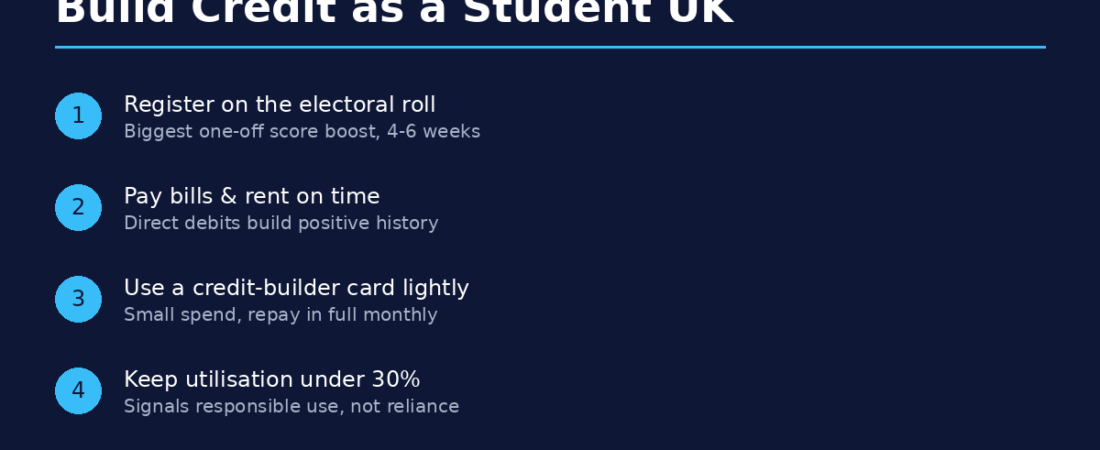
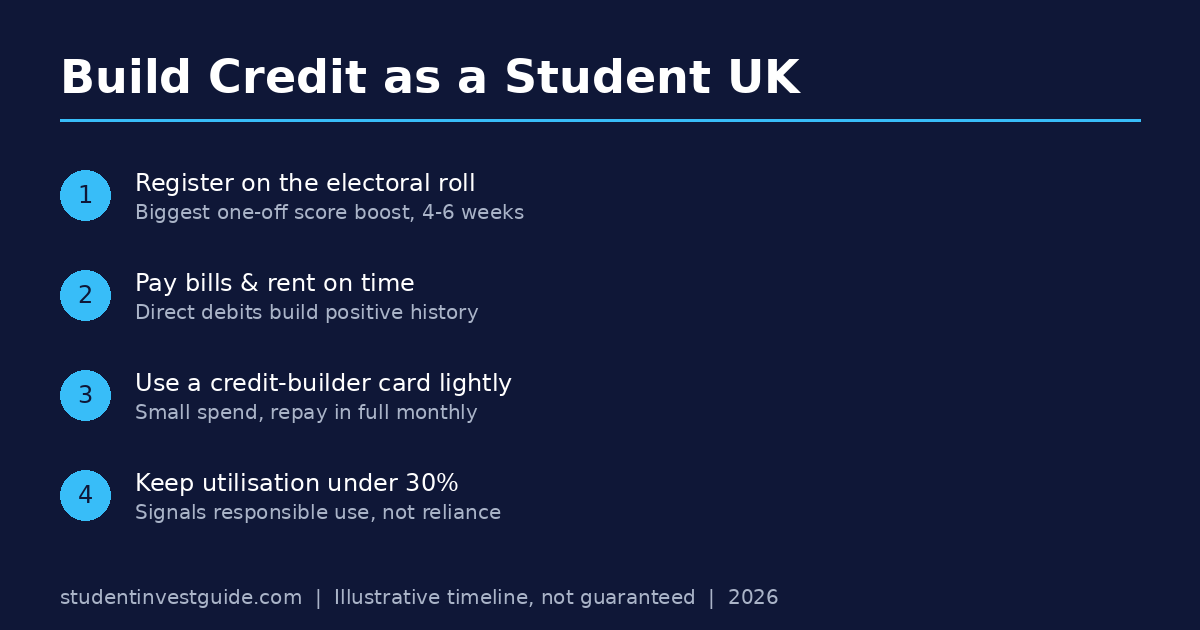
- Register on the electoral roll. This is the single biggest one-off improvement most students can make — CRAs typically pick up the change within four to six weeks, and it can lift a score noticeably because it confirms your identity and address.
- Pay bills, rent, and phone contracts on time. University is often the first time a student manages recurring payments directly. Direct debits for phone contracts and household bills that report to CRAs build a positive track record.
- Keep utilisation low on any credit product. Using under 30% of an available limit consistently and repaying in full each month signals responsible use rather than reliance on credit.
- Avoid multiple applications in a short window. Every hard credit search leaves a mark. Several applications close together can suggest financial pressure to a lender, even if each individual application is approved.
A student loan itself does not affect your credit score — it is administered separately by the Student Loans Company and does not appear on a standard CRA file the way a bank loan or credit card would.
Credit-Builder Cards: What They Are For
For students who want to build credit as a student through an active product rather than passive habits alone, a credit-builder card is a standard credit card with a low limit and a higher APR, designed for people with little or no credit history rather than for everyday spending. Used correctly — one small planned purchase a month, repaid in full by direct debit — it builds a positive payment record without carrying real debt.
| Product | APR Representative (variable) | Best For | FCA Regulated |
|---|---|---|---|
| Aqua Classic | 39.9% | Students with no credit history at all | Yes |
| Capital One Classic | 34.9% | Second/third-years with some history (overdraft, direct debits) | Yes |
| Interest-free student overdraft only | 0% within agreed limit | Students who prefer not to hold a credit card at all | Yes |
Figures correct as of July 2026, based on each provider’s published representative APR; your actual rate depends on individual credit assessment.
Risks and Limitations
Trying to build credit as a student deliberately carries real risks if it is not managed carefully, and no method here guarantees a specific score outcome.
- A missed payment is worse than no history. An empty credit file is neutral. A missed or late payment on a credit-builder card is an active negative mark that can take months to offset — it can leave you worse off than if you had never opened the card.
- Credit-builder APRs are high. Aqua and Capital One Classic both carry APRs well above standard cards, specifically because they are underwriting higher-risk applicants. Carrying a balance rather than repaying in full erodes any credit-score benefit with real interest cost.
- An overdraft is still debt, and using it is recorded. Applying for and using a student overdraft appears on your credit file and can influence future lending decisions, including mortgage applications after graduation, even though it costs nothing in interest while within the interest-free limit.
- Underperformance scenario. A student who opens a credit-builder card, spends near the full limit rather than a small planned amount, and then misses a payment during a busy exam period could see their score fall below where it started — the opposite of the intended outcome.
Worked Example: Utilisation and the Cost of Carrying a Balance
Say a student opens an Aqua Classic card with a £500 limit and spends £30 a month on a fixed subscription, repaying the balance in full each time. Utilisation sits at 30 / 500 = 6%, comfortably under the 30% threshold generally considered responsible use — for illustrative purposes only, as CRA scoring models are not published in full.
Compare that with a student who instead carries a £200 balance on the same card for six months at the representative 39.9% APR. Simple interest on that balance works out at approximately £200 × 0.399 × (6/12) = £39.90 in additional interest — a real cost with no corresponding credit-score benefit, since carrying a balance does not improve utilisation the way full repayment does.
Set up a direct debit to clear a credit-builder card in full every month before you make the first purchase. Missing even one payment while sorting out the mechanics can undo months of progress — automate it before you use the card, not after.
Analyst Note
📩 Get our free Student Investor Checklist — 10 steps before you invest your first £100. Download free →
Frequently Asked Questions
Does having a student loan affect my credit score in the UK?
No. Student loans are administered by the Student Loans Company, not a standard commercial lender, and do not appear on your Experian, Equifax, or TransUnion file the way a bank loan or credit card would.
How long does it take to build credit as a student in the UK?
Most people reach what CRAs would consider a “good” score within 12 to 18 months of consistent habits — electoral roll registration, on-time bill payments, and responsible credit-builder card use. There is no guaranteed timeline, and individual results vary.
Is registering on the electoral roll really necessary to build credit?
It is not legally required to hold credit, but it is typically the single biggest one-off score improvement available to most students, since it confirms your identity and address to lenders. CRAs usually reflect the change within four to six weeks of registering.
Conclusion
Building credit as a student is a slow, deliberate process built on a small number of consistent habits rather than any single shortcut. Electoral roll registration, on-time payments, and disciplined use of a low-limit credit-builder card do more for a student’s file over 12 to 18 months than any one product choice — far more than chasing the single lowest-APR card or the single best-rated provider. For the mechanics of opening the account these habits run through, see our guide to opening a student bank account.
Getting Started This Term
Students who want to build credit as a student while at university can realistically complete the first two steps — electoral roll registration and setting up a direct debit for a phone or utility bill — within the first few weeks of term, well before any credit-builder card application is even worth considering.
Before you build credit as a student through any new product, it is worth checking your existing file first. Experian, Equifax, and TransUnion all offer free access to your own statutory credit report, and reviewing it first shows whether you already have some history through a student overdraft or phone contract, which changes whether a credit-builder card is the right next step or premature.
Students who build credit as a student gradually, rather than applying for several products at once, tend to see steadier score improvement with fewer hard-search marks working against them in year one. Spacing applications by several months, rather than weeks, gives each new account time to establish a track record before a lender assesses the file again.
Will checking my own credit report hurt my score?
No. Checking your own report through Experian, Equifax, or TransUnion is a “soft search” and has no impact on your score, unlike the “hard search” a lender performs when you formally apply for credit. Students who want to build credit as a student should check their file periodically without hesitation — it costs nothing and carries no risk.
Related reading: Student Credit Card Safety UK 2026: How to Avoid Fraud, Skimming and Scams.