
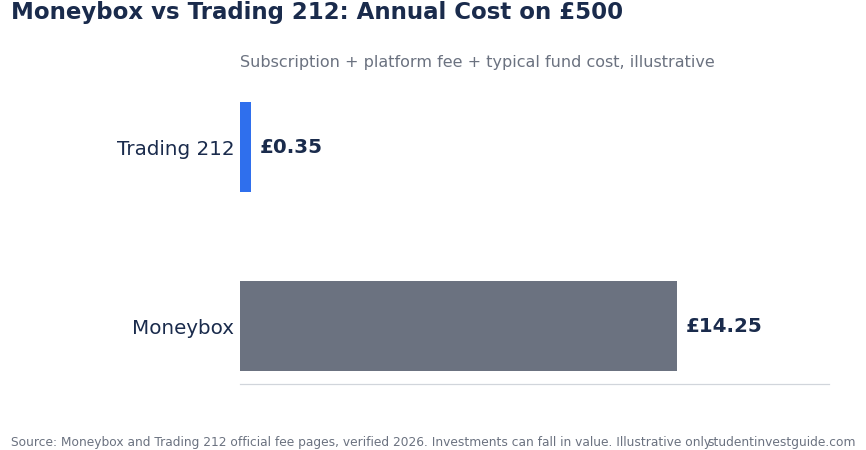
Quick Answer
Moneybox and Trading 212 are two of the most-used investing apps for UK students in 2026. Moneybox offers an automated Stocks and Shares ISA with round-up deposits and a Lifetime ISA option. Trading 212 offers commission-free access to 12,000+ instruments from £1. Neither constitutes personalised financial advice — all investments carry risk and returns are not guaranteed.
Regulatory Transparency & Disclosure: Student Invest Guide is an independent financial commentary platform. This article may contain affiliate links which support the site at no additional cost to the user.
Last reviewed: 10 June 2026. Fee data sourced from official platform pricing pages. Regulatory status verified via the FCA Register.

1. What Are Moneybox and Trading 212?
Table of Contents
Choosing between Moneybox vs Trading 212 for UK students is one of the most common investing questions we get. Both apps let you start with small amounts, but they work very differently — and the right pick depends on how hands-on you want to be.
Trading 212 is a commission-free brokerage offering direct access to over 12,000 equities, ETFs, and fractional shares from £1. It operates an Invest account, a Stocks and Shares ISA, and CFD products — students should use only the Invest or ISA account. Trading 212 UK Ltd is authorised and regulated by the FCA (firm reference: 609146). Client assets in the ISA are protected by the Financial Services Compensation Scheme (FSCS) up to £85,000.
Both platforms target beginners, but they differ materially in cost structure, asset access, and how much decision-making they require from the user. This comparison covers fees, ISA access, LISA eligibility, instrument range, and the practical cost difference over a typical student investment horizon. It is for illustrative and informational purposes only and does not constitute personalised financial advice.
2. How Each Platform Works
Moneybox — automated ISA investing: After linking a debit card and selecting a portfolio risk level (Cautious, Balanced, or Adventurous), Moneybox batches daily round-ups into a weekly investment into a globally diversified ETF portfolio. Users can also set weekly or one-off top-ups. The platform charges a £1/month subscription fee plus a 0.45% annual platform fee on assets under management. Underlying fund costs (ongoing charges figure, OCF) add approximately 0.12–0.22% depending on portfolio choice. The LISA adds a 25% government bonus on contributions up to £4,000 per tax year — but carries a 25% withdrawal penalty if used for anything other than a qualifying first home purchase or retirement after age 60, effectively reducing your own contributions, not just the bonus.
Trading 212 — self-directed ISA investing: No subscription. No trading commission. Users select their own stocks or ETFs, or use the AutoInvest feature to automate regular contributions into a customised or pre-built investment pie. The platform earns revenue through the bid-ask spread on its CFD product (entirely separate from the ISA). Interest on uninvested ISA cash is paid at up to 5.1% AER (variable, as of June 2026 — subject to change with Bank of England base rate movements; current BoE rate: 3.75%). The £20,000 ISA allowance for 2025/26 applies under standard HMRC ISA rules.
3. Key Benefits Side by Side
Where Moneybox leads:
- Lifetime ISA (LISA): One of the few retail platforms offering a LISA with a 25% government bonus — worth up to £1,000/year for students saving toward a first property.
- All three ISA types in one app: Cash ISA, Stocks and Shares ISA, and LISA — students can hold and switch between tax wrappers without needing multiple accounts.
- Structured portfolio selection: Three risk-profiled portfolios remove the need for fund selection, making it genuinely beginner-appropriate.
- Automated behaviour: Round-up investing creates a savings habit without requiring active deposits — behaviorally effective for irregular student income.
Where Trading 212 leads:
- Zero platform fee: No monthly subscription, no percentage charge — the only cost is the underlying ETF’s OCF (e.g. 0.07% for iShares MSCI World ETF SWDA).
- Fractional shares from £1: Access to partial shares in Apple, Nvidia, and global ETFs with no minimum trade size.
- 12,000+ instruments: Full access to individual equities, sector ETFs, bond ETFs, and thematic funds across 15 exchanges — versus Moneybox’s curated 30-fund range.
- Competitive cash interest: Up to 5.1% AER on uninvested ISA cash — effectively a high-yield cash component while waiting to deploy funds.
- AutoInvest pies: For students who want automation without paying a platform fee, Trading 212’s recurring investment pies replicate Moneybox’s automation at zero added cost.
4. Risks and Limitations
Moneybox — fee drag at small balances: The £1/month subscription (£12/year) is a fixed cost regardless of portfolio size. On a £300 balance, this alone represents a 4% annual charge before the 0.45% platform fee and fund OCF. A student investing £25/month who takes 12 months to reach £300 would pay more in platform fees than in any single investment gain at typical market returns. The total cost at sub-£500 balances can exceed 3–4% per year — a significant drag on compound growth. For context, the iShares MSCI World ETF on Trading 212 carries a total cost of approximately 0.07% p.a.
Trading 212 — behavioural and structural risks: Greater access creates greater opportunity for poor decisions. Academic research on retail investor behaviour consistently shows that portfolios with more frequent intervention underperform passive, undisturbed strategies. The platform’s breadth of instruments includes highly volatile individual stocks and thematic ETFs that carry concentrated risk unsuitable for a core student portfolio. The CFD product on the same app — prominently visible — carries leverage risk and the majority of retail CFD accounts lose money; students must ensure they are in the Invest or ISA section, never CFDs. Additionally, Trading 212 UK Ltd is FCA-regulated under temporary permissions following its Bulgarian parent structure — while FSCS protection applies to the ISA account, this structural nuance is worth understanding before opening an account.
Underperformance scenario — market correction: A student investing £1,000 in January 2022 into a global equity ETF on either platform would have seen their portfolio fall to approximately £750–£800 by October 2022 (MSCI World declined approximately 20% in GBP terms that year). The investment recovered by mid-2023, but students who withdrew during the drawdown crystallised a loss. Neither platform prevents panic selling — this is the most realistic risk for a short-horizon student investor.
Common to both: All equity investments can fall in value. Neither platform’s returns are guaranteed. Withdrawing from a Moneybox LISA outside a qualifying event triggers a 25% government penalty charge — this is not a typo; the penalty is structured so that, at a 5% return on the bonus, you can lose money you personally contributed. See the full HMRC Lifetime ISA guidance before contributing.
The Moneybox £1/month fee is the key variable. At £300 it costs 4%+ annually. At £3,000 it costs 0.4%. The break-even point against Trading 212’s 0% platform fee — accounting for the 0.45% AoM charge — is approximately £2,700 in assets, where total annual costs become roughly equal. Below that, Trading 212 is materially cheaper on a total-cost basis.
Analyst Note
📩 Get our free Student Investor Checklist — 10 steps before you invest your first £100. Download free →
5. Full Feature Comparison Table
| Feature | Moneybox | Trading 212 |
|---|---|---|
| Monthly subscription fee | £1/month (£12/year) | £0 |
| Annual platform fee | 0.45% of assets | 0% |
| Typical fund OCF | 0.12–0.22% | 0.07% (iShares MSCI World) |
| Total cost on £500 | ~£14.25/year (2.85%) | ~£0.35/year (0.07%) |
| Total cost on £3,000 | ~£25.50/year (0.85%) | ~£2.10/year (0.07%) |
| Stocks and Shares ISA | Yes | Yes |
| Lifetime ISA (LISA) | Yes — 25% govt bonus | No |
| Cash ISA | Yes — up to 5.17% AER | No |
| Fractional shares | No | Yes — from £1 |
| Instrument range | ~30 pre-selected funds | 12,000+ stocks & ETFs |
| Round-up investing | Yes | No (AutoInvest pies instead) |
| Cash interest on uninvested funds | N/A (S&S ISA) | Up to 5.1% AER (variable) |
| Minimum deposit | £1 | £1 |
| FCA regulated | Yes (FRN: 735054) | Yes (FRN: 609146) |
| FSCS protected | Yes — up to £85,000 | Yes — up to £85,000 (ISA) |
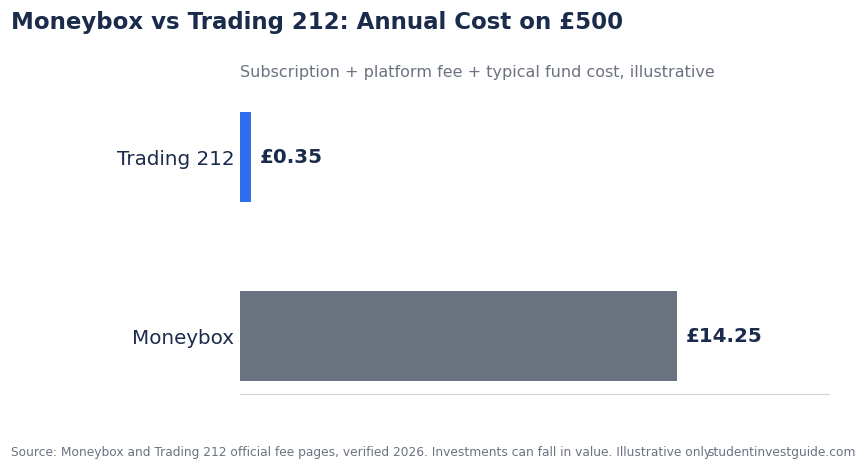
Fee data sourced from official platform pricing pages, June 2026. Total cost figures are illustrative calculations based on quoted fees; actual costs depend on portfolio value and investment activity.
6. Practical Calculation: £50/Month Over Five Years
Assumptions (illustrative — not a forecast or guarantee): £50 invested monthly for 60 months (£3,000 total contributions); 7% average gross annual return (consistent with long-run MSCI World index returns in GBP, net of currency effects — past performance is not a reliable indicator of future results); fees deducted annually on average portfolio value.
Trading 212 — iShares MSCI World ETF (OCF 0.07%):
Average portfolio value over 5 years: ~£1,800
Annual fee on average balance: £1,800 × 0.07% = £1.26/year
Total fees over 5 years: ~£6.30
Approximate end value before fees: £3,572 | After fees: ~£3,566
Moneybox — Adventurous portfolio (platform 0.45% + sub £12/year + fund OCF ~0.17%):
Annual platform charge on £1,800 average: £1,800 × 0.62% = £11.16 + £12 sub = £23.16/year
Total fees over 5 years: ~£115.80
Approximate end value before fees: £3,572 | After fees: ~£3,456
Difference: ~£110 in additional fees over five years on identical underlying exposure — equivalent to more than two months’ contributions. Compounded over 10 or 15 years the gap widens materially. All figures are illustrative only and based on simplified assumptions. For ISA allowance and tax rules see HMRC’s ISA guidance.
Who Should Use Which Platform?
This is not a one-size-fits-all question. Use the framework below based on your situation, not on which app looks better marketed:
- You are saving for a first home (under 40): Open a Moneybox LISA first. The 25% government bonus on up to £4,000/year is the most valuable financial product available to eligible UK students and cannot be replicated elsewhere. Use Trading 212 for additional investing above the LISA contribution.
- You have under £500 and no specific savings goal: Trading 212 is significantly cheaper. Start there with a global index ETF. Review if Moneybox’s automation would add value once your portfolio grows past £2,000.
- You want full automation and no product decisions: Moneybox. The round-up mechanism and three-portfolio system are genuinely effective for students with irregular income and low engagement.
- You want to learn how investing works: Trading 212’s broader instrument access and transparent portfolio tools are better for developing financial literacy — you can observe individual ETF performance, sector allocation, and rebalancing mechanics directly.
- You want both: This is legitimate. Hold a Moneybox LISA for the government bonus and invest additional funds in a Trading 212 Stocks and Shares ISA — provided total subscriptions across all ISAs stay within the £20,000 annual allowance and you do not subscribe to two ISAs of the same type in the same tax year.
7. Frequently Asked Questions
Does Moneybox charge fees on a Stocks and Shares ISA?
Yes. Moneybox charges a £1/month platform subscription fee (£12/year) plus a 0.45% annual fee on the value of assets held in a Stocks and Shares ISA. Underlying fund ongoing charges (OCF) apply on top, typically 0.12–0.22% depending on the portfolio selected. On a balance below approximately £2,700, these combined costs are higher in percentage terms than Trading 212’s fee-free structure. Fee data is correct as of June 2026; always check the Moneybox pricing page for current rates.
Is Trading 212 safe for UK students to use?
Trading 212 UK Ltd is authorised and regulated by the FCA (FRN: 609146 — verifiable on the FCA Register). Client money and assets in the ISA account are held in segregated accounts and are covered by the Financial Services Compensation Scheme (FSCS) up to £85,000 in the event of firm failure. The primary risk is investment performance — equities can and do fall in value, and returns are not guaranteed. Students must use the Invest or ISA account only; the platform’s CFD product is a separate, high-risk product not appropriate for beginners.
Can I use a Moneybox LISA and a Trading 212 ISA at the same time?
Yes — a Lifetime ISA and a Stocks and Shares ISA are different ISA types, so you can subscribe to both in the same tax year. However, you cannot hold two Stocks and Shares ISAs (from any providers) and subscribe to both in the same tax year. Your total contributions across all ISAs cannot exceed £20,000 in the 2025/26 tax year. For full eligibility rules and LISA restrictions see HMRC’s Lifetime ISA guidance. If in doubt, consider seeking independent financial advice before opening multiple tax wrappers.
8. Verdict
The data points in one direction for most students starting out: Trading 212 is the lower-cost platform for general equity investing, with materially lower fees, broader instrument access, and no penalty for starting small. If the Lifetime ISA government bonus is relevant to your circumstances — and for most UK students under 40 saving toward a first home, it will be — Moneybox is the correct choice for that specific wrapper.
The right answer for the majority of students is not either/or. Open a Moneybox LISA if you are eligible and saving for a property. Use a Trading 212 ISA for broader equity investing. Understand the fee structure of both before committing. For a broader look at platform options, see our Best Stocks and Shares ISA for Students UK 2026 full comparison and Best Investment Apps for Beginners UK 2026 guide. If you are new to investing entirely, our How to Start Investing as a Student UK guide covers the foundational concepts before you open any account.
All investments carry risk. The value of investments can fall as well as rise and you may get back less than you invest. Capital is at risk. Nothing in this article constitutes personalised financial advice. Past performance is not a reliable indicator of future results.