
Quick Answer
Moneybox vs InvestEngine UK 2026: Moneybox charges £1/month plus 0.45% and offers a Lifetime ISA with round-up saving; InvestEngine's DIY option has zero platform fee but no LISA. On a £1,000 pot, InvestEngine DIY costs about £17 less per year. Investments can fall in value.
Regulatory Transparency & Disclosure: Student Invest Guide is an independent financial commentary platform. This article may contain affiliate links which support the site at no additional cost to the user.
Moneybox vs InvestEngine: What’s the Real Difference?
Moneybox vs InvestEngine UK 2026 comes down to a simple trade-off: Moneybox is a round-up and habit-building app that also offers a Lifetime ISA, aimed at students who want investing made automatic. InvestEngine is a fee-free DIY ETF platform (with an optional 0.25% managed option) aimed at students who want lower costs and more control over what they hold. Both are FCA-regulated. Investments can fall in value.
How Each Platform Works
Moneybox rounds up your card purchases to the nearest pound and invests the spare change automatically, alongside regular deposits. You choose from a small set of ready-made fund portfolios (Cautious, Balanced, Adventurous). Accounts available: Stocks & Shares ISA, General Investment Account, Stocks & Shares Lifetime ISA, and Cash ISA/LISA. See our Moneybox review UK 2026 for the full feature breakdown.
InvestEngine offers two routes: build your own portfolio from over 600 ETFs with zero platform fee (DIY), or let InvestEngine’s team manage a portfolio for 0.25% a year (Managed). Accounts available: Stocks & Shares ISA, SIPP, General Account, and Business Account — but no Lifetime ISA or Cash ISA. See our InvestEngine review UK 2026 for more detail.
Key Benefits
- Moneybox’s round-ups build a saving habit passively, useful for students who struggle to invest manually.
- Moneybox’s Lifetime ISA pays a 25% government bonus toward a first home or retirement — InvestEngine has no LISA at all.
- InvestEngine’s zero platform fee on DIY portfolios means small student-sized balances aren’t eroded by a flat monthly charge.
- InvestEngine’s fractional investing across 600+ ETFs gives more control over exact asset allocation than Moneybox’s three ready-made portfolios.
- Both are FCA-regulated and covered by the FSCS deposit/investment protection scheme up to £85,000.
📩 Get our free Student Investor Checklist — 10 steps before you invest your first £100. Download free →
Risks and Limitations
Any Moneybox vs InvestEngine UK comparison has to account for risk, not just fees. Both platforms carry investment risk — the value of funds and ETFs can fall as well as rise, and past performance is not a guide to future returns. Moneybox’s £1/month subscription plus 0.45% platform fee is a fixed drag that disproportionately affects small balances: on a £200 pot, the £12/year subscription alone is equivalent to a 6% annual fee.
InvestEngine’s DIY option has no platform fee, but choosing your own ETFs without guidance carries the risk of poor diversification if a student picks concentrated, high-risk funds without understanding the underlying holdings. Neither platform’s Managed or ready-made options are personalised financial advice — for illustrative purposes only, based on FCA guidelines.
Moneybox vs InvestEngine: Fee Comparison
| Platform | Platform Fee | Subscription | LISA Available | FCA Regulated |
|---|---|---|---|---|
| Moneybox | 0.45% p.a. | £1/month (first 3 months free) | Yes | Yes |
| InvestEngine (DIY) | 0% p.a. | None | No | Yes |
| InvestEngine (Managed) | 0.25% p.a. | None | No | Yes |
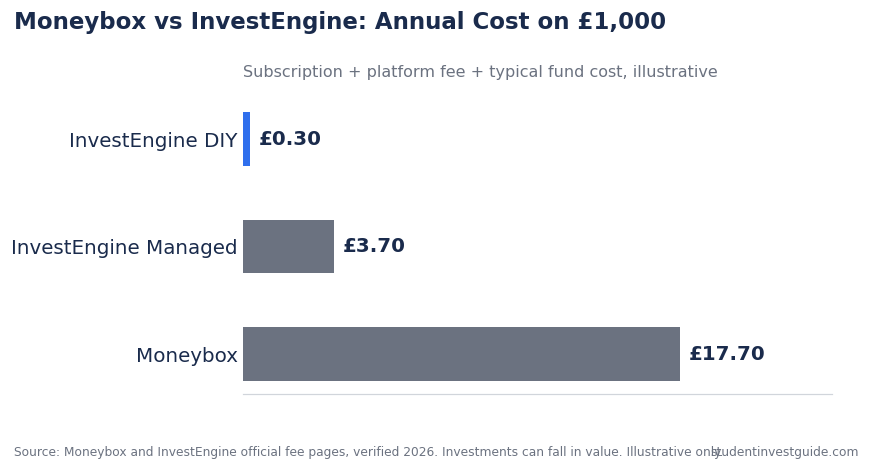
Platform fees confirmed against Moneybox’s official fee breakdown and InvestEngine’s official costs page, both checked 2026-07-04. Fund/ETF costs are separate and vary by fund chosen. For a lower-cost automated alternative, students can compare the round-up feature against Moneybox vs Trading 212.
Worked Example: £1,000 in a Stocks & Shares ISA for One Year
For illustrative purposes, assume a student holds a steady £1,000 balance for 12 months, is already past Moneybox’s 3-month free period, and chooses a low-cost global tracker fund (typical fund cost ~0.12% p.a. on both platforms).
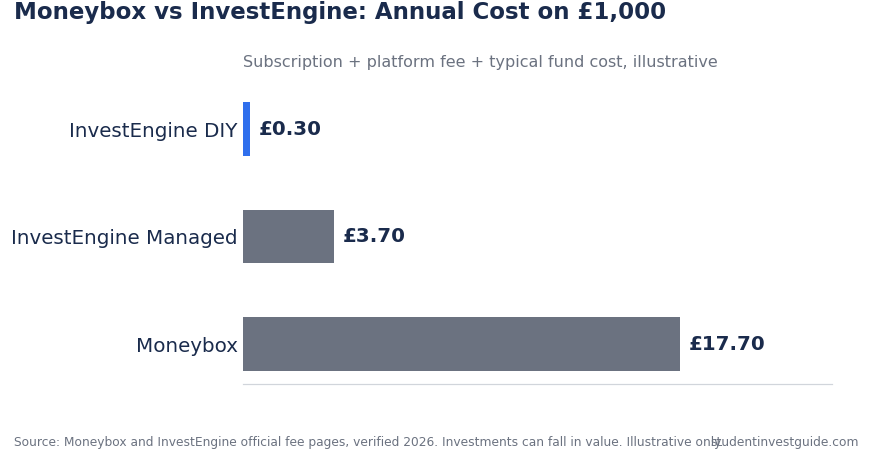
- Moneybox: £12 subscription (£1 × 12) + £4.50 platform fee (0.45% × £1,000) + £1.20 fund cost = £17.70 total
- InvestEngine DIY: £0 platform fee + £0.30 fund cost (from 0.03% p.a.) = £0.30 total
- InvestEngine Managed: £2.50 platform fee (0.25% × £1,000) + £1.20 average fund cost = £3.70 total
On a small student-sized pot, Moneybox’s flat £1/month subscription is the single biggest cost driver — InvestEngine DIY works out roughly £17 cheaper over a year on this example. This gap narrows as the balance grows, since Moneybox’s subscription fee doesn’t scale with pot size the way its 0.45% platform fee does.
Frequently Asked Questions
Is Moneybox or InvestEngine cheaper for students?
On a like-for-like Moneybox vs InvestEngine UK comparison, InvestEngine’s DIY option is cheaper for most students, since it has no platform fee and no monthly subscription. Moneybox charges £1/month plus a 0.45% platform fee, which is proportionally expensive on small balances typical of students.
Does InvestEngine offer a Lifetime ISA?
No. InvestEngine does not currently offer a Lifetime ISA, Cash ISA, or Junior ISA — only a Stocks & Shares ISA, SIPP, General Account, and Business Account. Students wanting the 25% LISA government bonus toward a first home need Moneybox or another LISA provider.
Is Moneybox worth the extra fee over InvestEngine?
It depends on what a student values. Moneybox’s round-up feature and Lifetime ISA can be worth the extra cost for students who want automatic saving habits or are saving toward a first home. Students who are comfortable choosing their own ETFs and want the lowest possible cost are typically better served by InvestEngine’s DIY option.
Moneybox vs InvestEngine: Which Should You Actually Choose?
Choose Moneybox if: the Lifetime ISA’s 25% government bonus is the priority, or automatic round-up saving habits matter more than shaving off the last fraction of a percent in platform fees. Its managed portfolios also suit a student who doesn’t want to select individual ETFs.
Choose InvestEngine if: minimising cost is the priority and a DIY portfolio of self-selected ETFs is acceptable — its 0% platform fee on the DIY tier undercuts Moneybox on every account size, though it comes at the cost of no Lifetime ISA at all.
Three-year cost comparison (illustrative): on a £1,000 Stocks and Shares ISA, InvestEngine’s DIY tier costs £0 in platform fees over three years. Moneybox’s £1/month (£36 over three years, after the first three months free) plus 0.45% platform fee (roughly £45-50 over three years on a modestly growing balance) totals approximately £80-85 over the same period. That gap only matters if the Lifetime ISA bonus isn’t being used — a student actively contributing to a LISA on Moneybox typically comes out well ahead once the 25% government bonus is factored in, since a £1,000 annual LISA contribution alone is worth a £250 bonus, dwarfing three years of platform fees several times over.
Managed vs DIY is the real trade-off, not just price. InvestEngine’s Managed portfolios charge 0.25%, positioning it between its own free DIY tier and Moneybox’s 0.45% — a student who wants some hands-off portfolio management but not Moneybox’s round-up features specifically might find InvestEngine Managed the middle ground.
Neither platform guarantees returns, and both are FCA-regulated with standard FSCS protection of £85,000 per person, per authorised firm, covering platform failure rather than investment losses from market movements. These figures are for illustrative purposes only and depend on actual contribution pattern, account balance, and market performance.
Switching later: a student can start on InvestEngine for the lower DIY cost and transfer into a Moneybox Lifetime ISA later once ready to use the LISA allowance, or vice versa — neither platform charges an exit fee for a standard transfer out, though in-specie ISA transfers between providers can take several weeks.
Moneybox vs InvestEngine UK comparisons like this one should be checked against each platform’s current fee page before making a final decision, since both providers review pricing periodically.
Both platforms are authorised and regulated by the Financial Conduct Authority, and neither should be treated as offering guaranteed or predictable investment returns.
A practical starting point: a student who knows they’ll use the Lifetime ISA allowance every year should lean Moneybox; a student who wants the lowest possible cost and doesn’t currently plan to use a LISA should lean InvestEngine. Fee schedules and product availability for both platforms are checked periodically and this comparison will be updated if either changes materially.
As with any investment platform comparison, current pricing is not a guarantee of future terms, and both providers can change fees with notice.
Always confirm current terms directly with Moneybox or InvestEngine before opening an account.
Conclusion
Moneybox and InvestEngine target different student needs rather than competing head-on. Moneybox trades a higher fee for automatic round-ups and Lifetime ISA access; InvestEngine trades hands-on fund selection for a lower — or zero — platform fee. Students should weigh whether the LISA bonus or the round-up habit is worth Moneybox’s extra cost, or whether InvestEngine’s DIY savings are more valuable. See our beginner’s guide to investing as a UK student for how to decide between platforms generally.