
Quick Answer
Freetrade vs Trading 212 UK 2026 compared: Trading 212 is fully free with a 0.15% FX fee but no SIPP. Freetrade's free Basic tier charges 0.99% FX (0.39% on the £9.99/month Plus plan) but includes a SIPP on every tier. Most students pay less on Trading 212 unless a SIPP matters. Investments can fall in value.
Regulatory Transparency & Disclosure: Student Invest Guide is an independent financial commentary platform. This article may contain affiliate links which support the site at no additional cost to the user.
Freetrade vs Trading 212 UK: The Core Difference
Comparing Freetrade vs Trading 212 UK comes down to fees and product range. Trading 212 is entirely free — no subscription tiers, a 0.15% FX fee, and 12,000+ stocks and ETFs, but no SIPP. Freetrade is free at its Basic tier but charges a much higher 0.99% FX fee there, dropping to 0.39% only on its £9.99/month Plus plan — and it offers a SIPP, which Trading 212 does not. Both are FCA-regulated and FSCS-protected up to £85,000 per person. For illustrative purposes, this is a factual comparison, not personalised financial advice.
How Each Platform Works
Trading 212 has one tier for everyone: a free Stocks and Shares ISA and General Investment Account, zero commission, zero platform fee, and a 0.15% FX fee on non-GBP trades. It also offers a Cash ISA (3.60% AER standard rate, tracking the Bank of England base rate). There is no SIPP. AutoInvest Pies let students automate monthly contributions into a custom basket of holdings, and a free practice account lets beginners test the platform with virtual money first. Full detail in our Trading 212 review.
Freetrade runs three tiers. Basic is free: a flexible Stocks and Shares ISA, SIPP, and General Investment Account, all commission-free, but with a 0.99% FX fee on non-GBP trades. Standard (£4.99/month on annual billing) cuts the FX fee to 0.59% and adds 2.5% AER on uninvested cash. Plus (£9.99/month) cuts the FX fee further to 0.39% and adds priority support and same-day withdrawals. Unlike Trading 212, Freetrade offers a SIPP on every tier, including Basic. Full detail in our Freetrade review.
Key Benefits Compared
- Lower FX fees on Trading 212 at every tier: 0.15% beats even Freetrade’s paid Plus tier (0.39%), let alone its free Basic tier (0.99%) — relevant for students buying US-listed stocks or ETFs.
- SIPP access only on Freetrade: students who want to start a pension alongside an ISA (common for final-year students starting graduate jobs) need Freetrade — Trading 212 has no pension product.
- No subscription required on Trading 212: every feature (bar the Cash ISA rate) is available for free, permanently — Freetrade’s lowest FX fee requires an ongoing £9.99/month payment.
- Interest on uninvested cash on Freetrade Standard/Plus: 2.5% AER, which Trading 212’s basic Invest/ISA accounts don’t directly match (though Trading 212’s separate Cash ISA pays 3.60% AER on cash held there specifically).
📩 Get our free Student Investor Checklist — 10 steps before you invest your first £100. Download free →
Risks & Limitations
Both platforms carry the same underlying market risk regardless of fee structure: the value of stocks and ETFs held through either can fall, and a global equity portfolio of the type available on both platforms fell by roughly 18% during the 2022 downturn — a real recent example of the downside case, not a guaranteed repeat.
Freetrade’s tiered pricing is a real-world friction: a student who signs up to Basic to save money, then later pays for Plus to get a lower FX fee, needs to actively track whether the £9.99/month cost is actually justified by their trading volume — for infrequent traders it usually isn’t. Trading 212’s SIPP gap is also a genuine limitation, not a minor one: a student who wants to consolidate a workplace pension or start a SIPP alongside their ISA cannot do both on Trading 212 and would need a second platform regardless.
Freetrade vs Trading 212: Comparison Table
| Platform | Key Feature | FX Fee | SIPP |
|---|---|---|---|
| Trading 212 | 12,000+ stocks/ETFs, AutoInvest Pies, practice account, Cash ISA | 0.15% (all users) | No |
| Freetrade | Tiered plans (Basic/Standard/Plus), SIPP included, interest on uninvested cash (Standard/Plus) | 0.99% Basic / 0.59% Standard / 0.39% Plus | Yes, all tiers |
Worked Example: FX Fee on a £1,000 US Stock Purchase
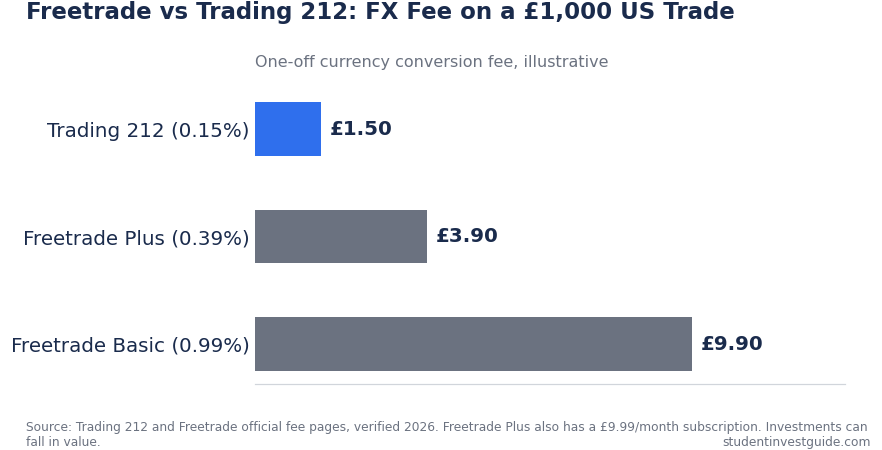
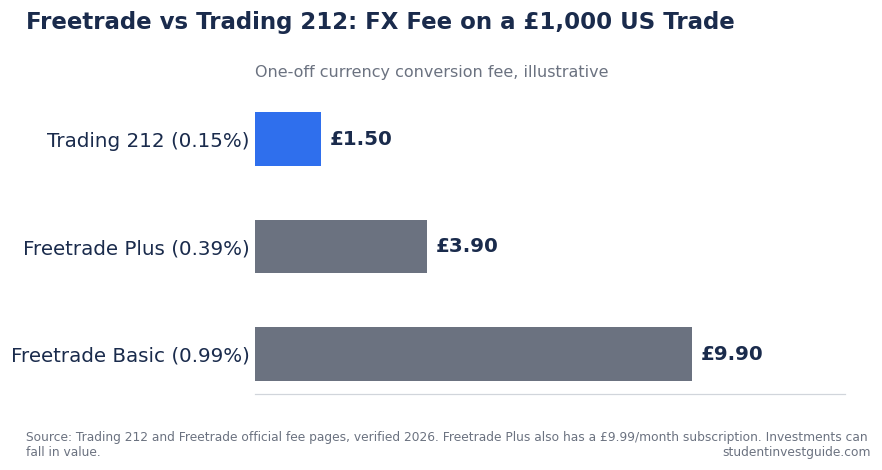
A student buying £1,000 of a US-listed stock pays the FX fee on the full amount, since it’s a non-GBP trade. On Trading 212: £1,000 × 0.15% = £1.50. On Freetrade Basic: £1,000 × 0.99% = £9.90 — £8.40 more for the same trade. On Freetrade Plus: £1,000 × 0.39% = £3.90, but that tier costs £9.99/month regardless of how much you trade, so it only pays off with frequent, sizeable non-GBP trades. For a student making occasional US stock purchases, Trading 212’s fee is lower in every scenario modelled here — illustrative maths, not a forecast of future costs or returns.
FAQs
Is Freetrade or Trading 212 cheaper for UK students?
Trading 212 is cheaper for most students: it’s entirely free with a 0.15% FX fee, beating Freetrade’s free Basic tier (0.99% FX fee) and even its paid Plus tier (0.39%, plus a £9.99/month cost).
Can I open a SIPP with Trading 212?
No. Trading 212 offers a Stocks and Shares ISA, Cash ISA, and General Investment Account, but no SIPP. Freetrade offers a SIPP on every plan, including its free Basic tier.
Do both platforms offer a flexible ISA?
Yes. Both Trading 212 and Freetrade offer flexible Stocks and Shares ISAs, meaning money withdrawn can be replaced in the same tax year without using up additional annual allowance.
Freetrade vs Trading 212: Which Should You Actually Choose?
Choose Trading 212 if: you trade internationally often or hold a mixed portfolio of UK and US stocks — its FX fee is meaningfully lower than Freetrade’s on every tier, and that gap compounds the more frequently you convert currency.
Choose Freetrade if: simplicity matters more than shaving fractions of a percent off FX conversion — its interface and fractional-share selection are generally considered more beginner-friendly, and for a student buying UK-listed ETFs almost exclusively, the FX fee difference barely applies.
Three-year cost comparison (illustrative): a student investing £100/month and converting roughly £600/year into US-listed stocks would pay approximately £18-20 more per year in FX fees on Freetrade than on Trading 212, based on the fee gap set out in the worked example above. Over three years that is a difference of roughly £55-60 — a real but modest amount, and one that only matters if US stock purchases are a meaningful part of the portfolio. For a portfolio that stays entirely in UK-listed funds and shares, this gap does not apply at all.
Neither platform guarantees returns, and both are subject to standard FSCS protection of £85,000 per person, per authorised firm — this covers platform failure, not investment losses from market movements. These figures are illustrative and depend on actual trading frequency, portfolio composition, and market conditions.
Switching later: both platforms support standard ISA transfers in, so a student who starts on one and later prefers the other’s fee structure isn’t locked in permanently — transfers can take several weeks and should be confirmed with the receiving platform before initiating.
Freetrade vs Trading 212 UK comparisons like this one should be read alongside each platform’s own current fee schedule, since FX rates and subscription tiers are reviewed and changed by both providers from time to time.
SIPP access: both Freetrade and Trading 212 offer a Self-Invested Personal Pension alongside their ISA, though a SIPP is rarely relevant for most undergraduates given the long lock-in until retirement age — it’s worth knowing it exists for later, but it shouldn’t influence which platform a student picks today.
Customer support and app reliability are broadly comparable between the two — both have had periods of app outages during high-volatility trading days, which is a known limitation across most UK commission-free brokers, not specific to either platform.
A practical starting point: a student who mostly buys UK-listed index funds and rarely touches US stocks will not notice much practical difference between Freetrade vs Trading 212 UK — pick whichever app’s interface feels more comfortable. The FX fee gap only becomes a real factor once US stock purchases become a regular, meaningful part of the monthly investing habit.
Both platforms are FCA-regulated and neither should be treated as offering guaranteed or predictable returns on any investment held through them.
Fee schedules and FX rates for both providers are checked periodically and this comparison will be updated if either changes materially.
As with any investment decision, past platform performance and current pricing are not guarantees of future terms.
Conclusion
Trading 212 and Freetrade both offer genuine, FCA-regulated ISA options, and the right choice depends on whether a SIPP matters to you now. Students focused purely on low-cost ISA investing will generally pay less on Trading 212; students who want a pension wrapper alongside their ISA need Freetrade. For a broader look at platform choice, see our beginner’s guide to investing as a UK student and our Trading 212 vs InvestEngine comparison.