
Quick Answer
Trading 212 and InvestEngine both offer commission-free, zero-platform-fee Stocks and Shares ISAs for UK students in 2026. Trading 212 covers individual stocks plus ETFs with AutoInvest pies; InvestEngine is ETF-only but adds a 0.25%/year Managed Portfolio option. Choose Trading 212 for stock-picking flexibility, InvestEngine for simpler ETF-only investing. Investments can fall in value.
Regulatory Transparency & Disclosure: Student Invest Guide is an independent financial commentary platform. This article may contain affiliate links which support the site at no additional cost to the user.
Trading 212 vs InvestEngine UK: What’s the Real Difference?
Comparing Trading 212 vs InvestEngine UK comes down to one core trade-off: Trading 212 gives students a zero-fee ISA covering individual shares and ETFs, while InvestEngine gives students a zero-fee ISA restricted to its own curated list of ETFs, plus an optional managed portfolio for those who don’t want to build their own. Both are FCA-regulated and FSCS-protected up to £85,000 per person. For illustrative purposes, this comparison is not personalised financial advice — it lays out the factual differences so a student investor can match the platform to how they actually want to invest.
How Each Platform Works
Trading 212 offers a Stocks and Shares ISA and a general Invest account with access to 13,000+ instruments — individual company shares, ETFs, and investment trusts. Its standout feature for beginners is AutoInvest Pies: a student can build a basket of holdings with target percentages and automate monthly contributions into it. A free practice account with virtual money lets first-time investors test the platform before committing real money. Full details are in our Trading 212 review.
InvestEngine offers a Stocks and Shares ISA and a General Account built entirely around ETFs — over 600 of them, spanning global equity, bond, and thematic funds. Rather than individual shares, students choose between a self-managed “DIY” portfolio (no platform fee) or a professionally allocated “Managed” portfolio (0.25% per year, on top of underlying ETF fees). There’s no practice account, but the ETF-only structure means less scope to accidentally buy something volatile or unsuitable. Full details are in our InvestEngine review.
Key Benefits Compared
- Zero platform fee on both DIY options: Trading 212’s ISA and InvestEngine’s DIY ISA both charge £0 in platform fees — the underlying cost sits in fund charges (for ETFs) or, on Trading 212, a 0.15% FX fee on non-GBP-denominated instruments.
- Broader instrument choice on Trading 212: students who want to hold individual company shares alongside ETFs need Trading 212 — InvestEngine’s ISA is ETF-only.
- A genuine hands-off option on InvestEngine: the 0.25%/year Managed Portfolio is built and rebalanced by InvestEngine, which Trading 212 does not offer as an equivalent product.
- A practice account on Trading 212: useful for a student investing for the first time who wants to learn the interface with virtual money before risking real deposits.
📩 Get our free Student Investor Checklist — 10 steps before you invest your first £100. Download free →
Risks & Limitations
Both platforms carry the same underlying market risk: the ETFs and shares available through either ISA can fall in value, and a global equity portfolio of the type both platforms are built around fell by roughly 18% during the 2022 market downturn — a real, recent example of the downside case, not a guaranteed repeat. Neither platform’s zero-fee structure removes this risk; it only removes platform-level cost drag.
InvestEngine’s ETF-only ISA is a real-world friction for a student who later wants to hold individual shares in the same tax wrapper — moving to a share-inclusive ISA generally means an account transfer, which can take days to weeks. On Trading 212, the flexibility to build custom Pies can also encourage frequent tinkering, which research on retail investor behaviour consistently links to lower long-run returns than a simple, left-alone portfolio. The 0.25%/year Managed Portfolio fee on InvestEngine is also a permanent drag that applies regardless of whether the portfolio grows or falls in a given year.
Trading 212 vs InvestEngine: Comparison Table
| Platform | Key Feature | Fee (ISA, DIY) | FCA Regulated |
|---|---|---|---|
| Trading 212 | Individual shares + ETFs, AutoInvest Pies, practice account | £0 platform fee, 0.15% FX fee (non-GBP) | Yes |
| InvestEngine | 600+ ETFs only; optional 0.25%/yr Managed Portfolio | £0 platform fee (DIY) | Yes |
Worked Example: Does the 0.25% Managed Portfolio Fee Matter?
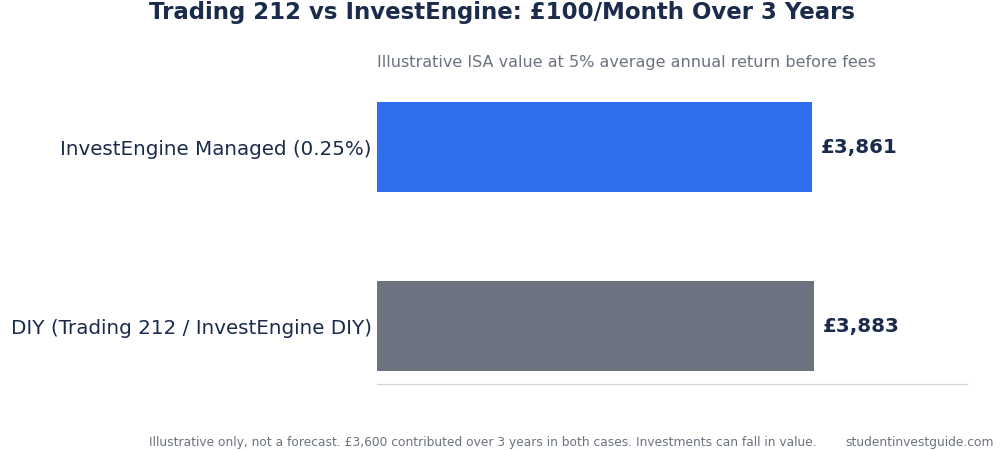
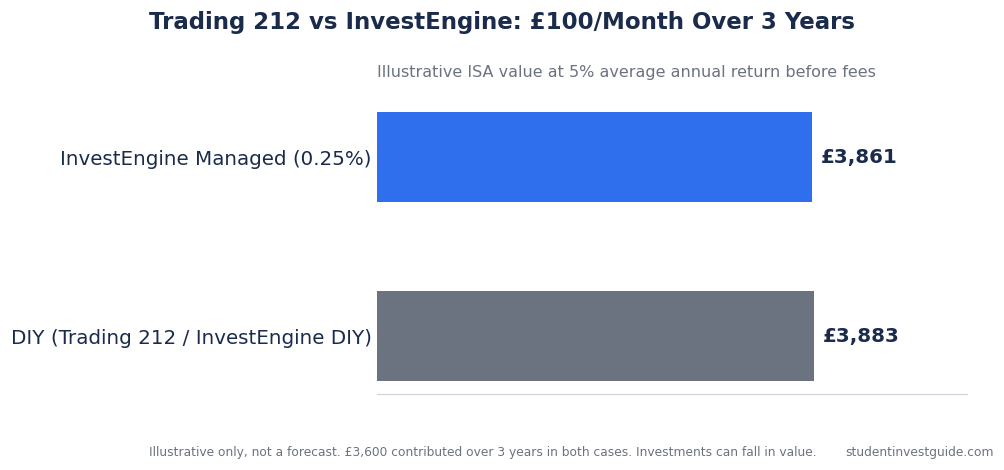
Assume a student contributes £100 a month into a Stocks and Shares ISA for 3 years (36 months), with an illustrative 5% average annual return before any platform fee. Using standard compound contribution maths, that grows to approximately £3,883 on a fee-free DIY portfolio (Trading 212, or InvestEngine’s DIY option) against £3,600 paid in — around £283 of growth, for illustrative purposes only.
Run the same £100/month for 3 years through InvestEngine’s Managed Portfolio instead, where the 0.25%/year fee effectively reduces the net return to roughly 4.75%, and the total comes to approximately £3,861 — about £22 less over 3 years on the same contributions. £22 looks small, but the same fee compounds on a larger balance over a longer period: on a 10-year, £200/month pattern the gap between a 0% and 0.25% annual fee widens substantially. This is illustrative maths, not a forecast — actual returns depend on markets and are never guaranteed.
FAQs
Is Trading 212 or InvestEngine better for students in the UK?
Neither is universally “better” — it depends on what a student wants to hold. Trading 212 suits students who want individual shares alongside ETFs and a free practice account. InvestEngine suits students who only want ETFs and either want to build their own portfolio for free or pay 0.25%/year for a managed one.
Do Trading 212 and InvestEngine charge platform fees on their ISAs?
Both charge £0 platform fee on their self-directed (DIY) Stocks and Shares ISA. Trading 212 adds a 0.15% FX fee on non-GBP-denominated instruments. InvestEngine’s Managed Portfolio option adds a separate 0.25%/year fee on top of underlying ETF costs.
Can I hold individual shares in an InvestEngine ISA?
No. InvestEngine’s Stocks and Shares ISA is restricted to its own list of 600+ ETFs. Students who want individual company shares in the same ISA wrapper need a platform like Trading 212 instead.
Trading 212 vs InvestEngine: Which Should You Actually Choose?
Choose Trading 212 if: you want to hold individual company shares alongside funds in the same ISA, or want access to fractional shares and a wider range of tradeable assets. Its 0% platform fee matches InvestEngine’s DIY tier, so cost isn’t the deciding factor between these two.
Choose InvestEngine if: a curated, ETF-only portfolio is genuinely preferred, or the Managed tier’s automatic rebalancing and portfolio-building tools appeal more than picking individual shares. Its restriction to its own list of 600+ ETFs is a limitation for stock-pickers but a non-issue for someone who only ever intended to buy diversified funds.
Cost comparison: on the DIY/self-select tiers, both platforms charge 0% platform fee, so there is no meaningful cost gap for a student building a simple ETF portfolio on either app. The real differentiator is InvestEngine’s Managed tier at 0.25%, which trades a fee for hands-off rebalancing — Trading 212 has no direct equivalent managed-portfolio product.
Neither platform guarantees returns, and both are FCA-regulated with standard FSCS protection of £85,000 per person, per authorised firm, covering platform failure rather than investment losses from market movements.
Switching later: a student who starts on InvestEngine for its curated ETF list and later wants individual shares can transfer to Trading 212, and vice versa — standard ISA transfers apply, typically taking several weeks, and should be confirmed with the receiving platform before initiating.
A practical starting point: a student who only ever plans to buy index funds and ETFs will find little practical difference between Trading 212 vs InvestEngine UK on cost — the choice mostly comes down to whether individual company shares or a curated, hands-off ETF experience is preferred.
Both platforms are authorised and regulated by the Financial Conduct Authority. Fee schedules and product ranges for both are checked periodically and this comparison will be updated if either changes materially — always confirm current terms directly with Trading 212 or InvestEngine before opening an account.
As with any investment platform, current pricing and product availability are not guarantees of future terms, and both providers can make changes with notice.
Neither Trading 212 nor InvestEngine should be treated as offering guaranteed or predictable investment returns of any kind.
Check each provider’s own site for the most current fee and product details before making a final choice.
This guide will be reviewed periodically as pricing changes.
Conclusion
Trading 212 and InvestEngine both offer genuinely fee-free ISA options for UK students, and the right choice depends on whether individual shares or a curated, ETF-only structure fits how you want to invest. Neither platform’s fee structure is a substitute for understanding the underlying risk — both hold investments that can fall in value. For a broader introduction before choosing either platform, see our beginner’s guide to investing as a UK student, and for ISA allowance rules see gov.uk’s ISA guidance.